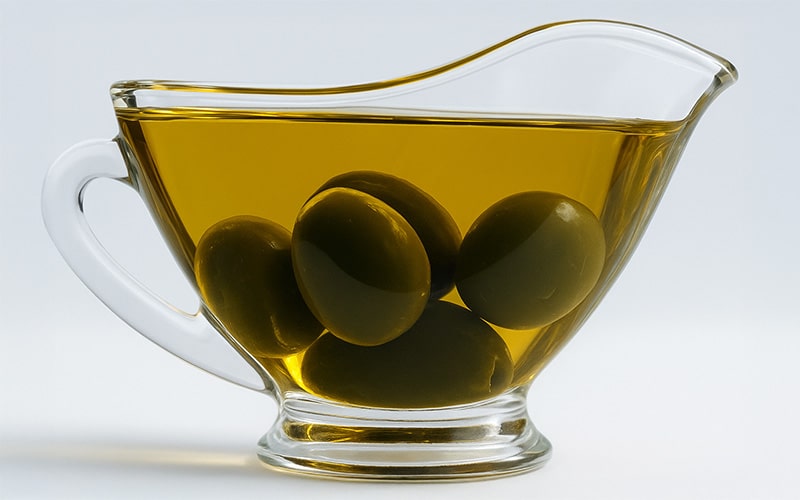
What exactly does virgin olive oil mean?
First-pressed olive oil is the purest and most natural form of olive oil. The term refers to the production process. The oil is obtained from the very first pressing of fresh olives, without heating or chemical means. This process is also known as cold pressing.
In this method, the olives are mechanically pressed at low temperature, usually below 27 degrees Celsius. This optimally preserves the flavour, aroma and nutrients. The resulting oil is rich in antioxidants, polyphenols and vitamin E - substances that contribute to good health.
In short: virgin olive oil is pure olive juice. No additives, no processing. Only the first drop of the highest quality.
The flavour of virgin olive oil is full-bodied, fruity and sometimes slightly peppery. The earlier the olives are harvested, the more intense and spicy the flavour. This makes it a favourite oil among chefs and gourmets.
The difference between ordinary olive oil and virgin olive oil
Not all olive oil is the same. The difference between ordinary olive oil and extra virgin olive oil is in the way it is produced as well as the quality.
Production process
- First-pressed olive oil: Obtained via cold, mechanical pressing of fresh olives. No heating, no chemical treatment.
- Ordinary olive oil: often a mixture of refined oil (processed with heat and filtration) and a small percentage of extra virgin oil for flavour.
Taste and smell
- Virgin olive oil has a distinct smell and taste. You taste notes of fresh fruit, nuts or green herbs, sometimes with a slight bitterness.
- Refined olive oil is much more neutral in taste and smell.
Nutritional value
First-pressed olive oil retains natural antioxidants and polyphenols that contribute to healthy heart function and cell protection. In refined oil, many of these substances are lost during the processing.
Acidity and quality
To bear the title extra virgin olive oil, the oil must have an acidity of no more than 0.8%. The lower the acidity, the better the quality.
In summary, virgin olive oil is fuller in flavour, better quality and richer in nutrients than ordinary olive oil.
When do you use virgin olive oil?
The rich flavour of virgin olive oil comes out best in dishes where you can really taste the oil. Think cold or lukewarm preparations such as:
- Over a salad or bruschetta
- As a dip with fresh bread
- In a dressing or marinade
- Over grilled vegetables or pasta as a finishing touch
Yet you can also fry just fine with virgin olive oil. The oil has a smoke point of around 180 degrees Celsius, so it is suitable for light to medium frying. For example, use it to sauté vegetables, fry eggs or fry fish briefly.
Be careful not to make it too hot. Above 180 degrees, some healthy substances can be lost. Want to fry or deep-fry at a high temperature? Then milder, refined olive oil is a better choice.
In short: use virgin olive oil cold for flavour and hot for mild preparations.